RDF#
RDF allows us to make statements about resources. The format of these statements is simple. A statement always has the following structure:
<subject> <predicate> <object>
An RDF statement expresses a relationship between two resources. The subject and the object represent the two resources being related; the predicate represents the nature of their relationship. The relationship is phrased in a directional way (from subject to object) and is called in RDF a property. Because RDF statements consist of three elements they are called triples.
Here are examples of RDF triples (informally expressed in pseudocode):
<Bob> <is a> <person>.
<Bob> <is a friend of> <Alice>.
<Bob> <is born on> <the 4th of July 1990>.
<Bob> <is interested in> <the Mona Lisa>.
<the Mona Lisa> <was created by> <Leonardo da Vinci>.
<the video 'La Joconde à Washington'> <is about> <the Mona Lisa>
The same resource is often referenced in multiple triples. In the example above, Bob is the subject of four triples, and the Mona Lisa is the subject of one and the object of two triples. This ability to have the same resource be in the subject position of one triple and the object position of another makes it possible to find connections between triples, which is an important part of RDF's power.
We can visualize triples as a connected graph. Graphs consists of nodes and arcs. The subjects and objects of the triples make up the nodes in the graph; the predicates form the arcs. Fig. 1 shows the graph resulting from the sample triples.
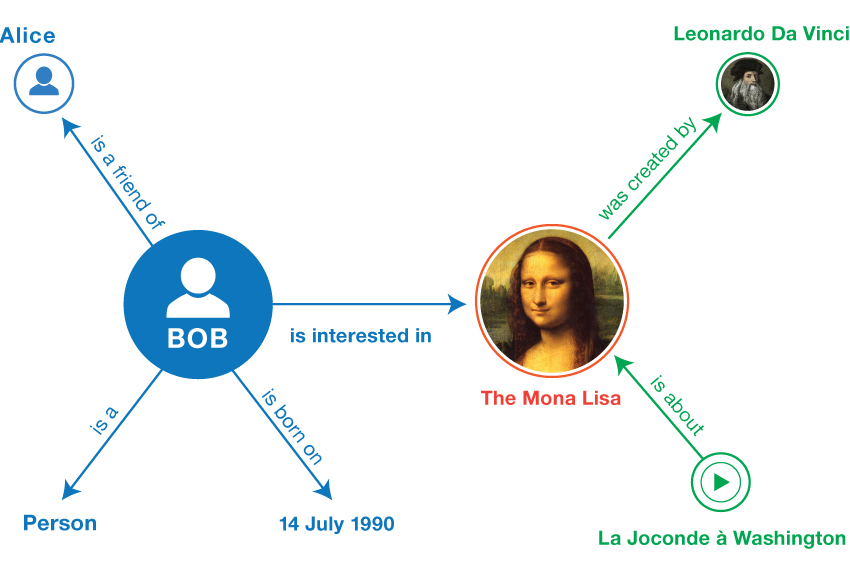 Source: W3C
Once you have a graph like this you can use SPARQL to query for e.g. people interested in paintings by Leonardo da Vinci (see SPARQL queries).
For more information, see RDF 1.1 Primer
Formats#
Laces Data Platform current accepts the following RDF formats, like Turtle (.ttl), N-Triples (.nt), N3 (.n3), RDF/XML (.rdf, .owl, .xml), JSON-LD (.jsonld), RDF/JSON (.rj)